
I’ll be honest with you. I was not a good student.
I couldn’t wait to get out of English class. The books felt boring, the assignments pointless, and whenever I asked why we were doing any of it, I never got a straight answer. So I checked out.
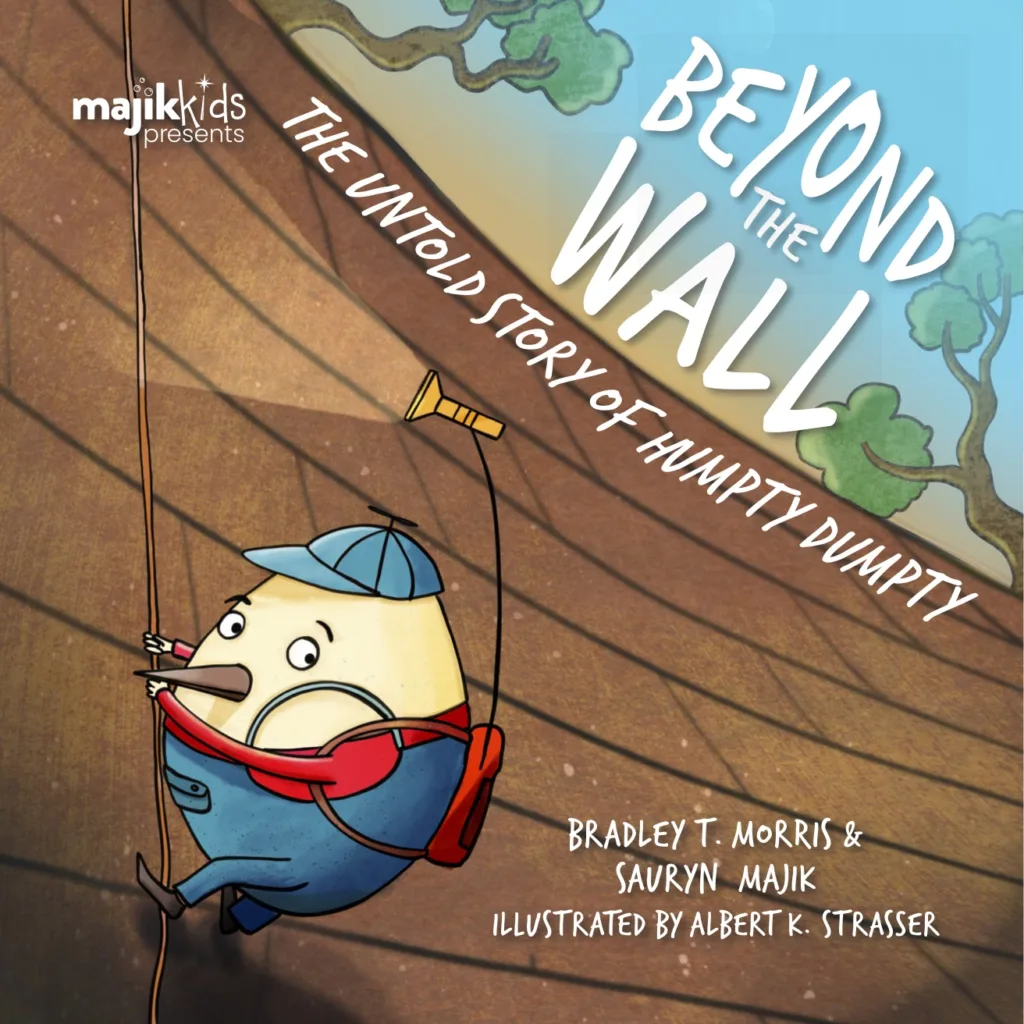
My son, Sauryn and I just celebrated writing our 25th story together. Video recap here.
He’s now working on his own independent graphic novel and writes the Saturday morning cartoon strip for our Majik Kids newsletter every single week (make sure you scroll down far enough to check those out every Saturday).
Story ideas come up at breakfast, in the car, before bed, out on dog walks… Our lives are soaked in storytelling, and I wouldn’t trade it for anything.
So when I got the chance to sit down with Julie Bogart, creator of Brave Writer and author of Help! My Kids Hate Writing, I knew this conversation was going to hit differently.
Writing Isn’t a School Subject. It’s How We Know Each Other.
Julie pointed to that universal parenting moment: waiting for your baby to say their first word. Mama. Dada. That electric moment when your child reaches across the space between you with language.
“Writing,” she said, “is merely the act of transcribing all of that internal language that we use to express who we are.”
That reframe is everything. Writing isn’t a skill to be tested or a box to check. It’s an extension of the most human thing we do: connect with each other through language.
The tragedy of how most schools approach writing is that it strips all of that away. Kids aren’t asked to express themselves.
They’re asked to solve a puzzle: “Fill in the five-paragraph template. Match what the teacher wants. Get the grade.”
And somewhere in that process, the spark dies.
Why AI Makes This More Urgent, Not Less
Julie’s take on artificial intelligence was honest & direct. She called AI “a big rip-off” when it comes to writing, not because the technology isn’t impressive, but because of what it takes away.
She’s right. Kids, with their completely un-jaded, un-clichéd brains, are extraordinarily good at original expression.
Julie told a story about her daughter describing a guitar and landing on the phrase “the color of an unripe cantaloupe.”
Has anyone, ever, described guitar wood that way? No. And no AI ever would.
That living, surprising, specific language inside our kids is irreplaceable. The more we outsource expression to AI, to templates, to fill-in-the-blank worksheets, the more we risk our kids never discovering it.
The Real Reason Kids Hate Writing (It’s Not What You Think)
When parents say “my kid hates writing,” they usually mean one of several very different things:
- bad handwriting,
- poor spelling,
- blank-page paralysis,
- or resistance to essays.
These are not the same problem, and treating them the same way is where things go wrong.
The deeper issue is what Julie calls the transcription gap.
Most five-year-olds are pretty fluent in their spoken language.
But when they’re seven or eight and just learning to write, they’re suddenly expected to funnel all of that fluency through a hand that can barely form letters at the pace thought moves.
So what do kids do? They dumb it down. They shrink the story to fit what they can physically manage.
The fix: be the transcriptionist.
Sit with your kid and let them talk the story while you write it down. Think of it like a stroller. Just because your toddler can walk doesn’t mean you never carry them again.
The transcription skills come with time. The voice, the ideas, the imagination need to be protected now.
What Handwriting Does to the Brain
A Norwegian neuroscientist named Audrey van der Meer led a study hooking university students up to 256-sensor brain scans while they wrote by hand or typed the same words on a keyboard. When students wrote by hand, multiple regions of the brain lit up together: memory, sensory processing, coordination, and focus. When they typed, that activity largely disappeared.
The reason: handwriting requires every letter to be formed through a unique combination of fine motor movement, spatial awareness, and real-time problem-solving. Typing repeats essentially the same motion regardless of the letter.
And here’s the alarming part: kids learning primarily on tablets are struggling to distinguish letters like b and d because they’ve never physically experienced forming them.
Julie’s suggestion before worrying about handwriting: let your kids play with modeling clay, build with Legos, and use big arm movements on giant sheets of paper on the wall.
Develop the hands first. The writing will come.
The Color Walk (Try This Tonight)
I asked Julie for a fun activity for families to try out tonight:
Everyone in the family privately picks a color. Don’t say it out loud. Then you go on a silent walk, and your only job is to notice where your color appears in the world around you.
When you get home, set a timer for five to seven minutes. Everyone writes, or dictates, everything they observed about their color, including its absence.
Julie’s son once picked orange in the middle of an Ohio winter. He came home and wrote an interview with the color orange about how it felt to be left out of an entire season.
That’s not a school assignment. That’s writing. That’s a kid discovering they have something worth saying.
The Parent Trap: Fix Your Face
When your child shows you their writing and the spelling is wild and the punctuation is non-existent, practice your reaction in the mirror.
The mechanics of writing: spelling, punctuation, handwriting, can all be taught. And they should be…
But Julie’s Brave Writer program teaches them separately, through copy work and dictation using beautiful existing texts. Not by red-penning your kid’s fragile, risky self-expression.
The moment we make a child feel that their best effort wasn’t good enough, we start closing the door on their voice. That door is much harder to reopen than it is to simply leave it wide open.
“Everything can teach anything, and anything can teach everything.”
Julie told the story of a homeschooled high schooler who refused to write essays until he asked if he could compare Journey to the Center of the Earth to Donkey Kong. He wanted to watch the original King Kong film too, because he saw the connections.
That’s not a kid avoiding learning. That’s a kid doing exactly what learning is supposed to be: finding meaning in the things that matter to him.
Help your kids write about things that matter to them and they won’t be able to stop writing!
Go Find Julie’s Work
Brave Writer at bravewriter.com serves hundreds of thousands of families across 191 countries. Their online classes, including world-building, comic book writing, and the five-paragraph essay, are asynchronous and run by real human teachers who give warm, curious, reader-response feedback. Not red pens. Real responses from people genuinely interested in what your child has to say.
Julie also hosts The Brave Writer Podcast and has two books worth your time: The Brave Learner and Help! My Kids Hate Writing. If your kid’s spark is dimming under the weight of homework and screens and structure, start there.
And if you want to hear the full conversation, watch or listen to this episode of the Majik Family Podcast. We go deep on neuroscience, AI, creativity, and what it actually looks like to raise a kid who creates rather than just consumes.
Because that kid? They’re already in there. We just need to make space for them.